1. I was a community health major in college, so I spent a lot of time talking about "herd immunity." The idea here is that if everyone around you is immune to a disease (say, measles), then you should theoretically be protected against the disease even if you are not immune. This is an important if imperfect tool for individuals who are vulnerable because they cannot build an immunity or, by ignoring vaccine recommendations, choose not to. But then the CDC comes out with a statement that there have been more cases of measles in the US in the last six months than there have been in any full year since 1996, where most of the cases are in children who have traveled out of the country to measles-endemic areas. I admit, this makes me angry. I understand one's right to have personal beliefs about vaccines, but physicians and physicians groups (hey, AMA) need to do better about educating the public about vaccines' benefits and about countering attacks of misinformation against vaccines.
2. Okay, so I finally understand that SGR -- sustainable growth rate -- is the Affordable Care Act's attempt at controlling Medicare costs by reducing physician reimbursements -- ah, that's why docs are up in arms. There's a bill making its way through Congress now that would address SGR by maintaining physicians' reimbursement rates for three years. Sounds good. The problem is that benefits would start at 67 instead of 65, wealthier seniors would have to pay additional premiums, and everyone would pay more for Part B (the outpatient stuff). Depending on what "additional pay" constitutes, I still might be okay with this. It is obviously difficult to ask seniors on fixed incomes to pay more and wait longer for Medicare, especially as pensions seem to be up for grabs -- my retired state-employed lawyer grandfather is staying with my family this week, and we had a long talk about the Minnesota and Colorado rulings that reduce pension plans for those already receiving them and how this might expand to other states. The aforementioned Medicare bill is tricky, but it might be part of a larger step toward dealing with The Medicare Problem.
3. It's news to no one that a lot of ER visits could be avoided by better primary care and coordinated care therein. Massachusetts officials recently stated as much, but the problem is primary care doctors can't always afford to hire extra nurses for follow-up management or to implement electronic health records systems. But Dr. Michael Cantor of the New England Quality Care Alliance and Tufts Medical Center had a great idea: Insurers that collect money for "care management" programs should forward it back to doctors. Cantor contends that doctors' offices handle the management better than the insurers anyway. If this idea were to become policy, it will be a hard fight, but I think it could go a long way in improving primary care outcomes.
4. When I look for health-related news, I tend to stick to the e-newsletters that are sent to me daily (or more): The AMA is good for big health news articles; MSSNY does a lot to tell you what's going on in New York; Medscape's articles are easier to digest and there are some good blogs and articles targeted at doctors-in-training ; and I've recently been introduced to MedPageToday.com, which has a good balance of policy news, health issues, and blog discussions (I really like this and wish I'd found it sooner). What do you read? If you have any recommendations, comment here or e-mail me at lgluck01@gmail.com!
Friday, July 1, 2011

Monday, June 27, 2011
Is the AMA Still Relevant?
It's been a week since the AMA-MSS Annual Meeting ended, and we're finally bringing you an update. The big big big news is that the MSS and the HOD proper (the physicians' voting body) reaffirmed policy to support an individual mandate in regard to health care (read more here). This is a major step forward for the historically conservative organization, and many have been blaming the AMA's stance on the individual mandate for the membership decline this past year. Others cite the platform as a reason for new members to have joined. But the AMA does only represent 20-30% of US doctors, which has brought up the question: Is the AMA still relevant?
We think so. Despite its poor-looking numbers, the AMA is one of the most powerful lobbying groups in Washington. It is the most powerful health care lobby. It advocates hard for physicians, and its support for universal (ish) health care does show that the group adheres to its motto, "Helping doctors help patients." A recent article at KevinMD.com said it best: "The AMA may not be every doctor’s cup of tea, but it’s the best voice we have. And that is better than no voice at all."
Whether or not you like the politics of medicine, it will affect you. Get involved. As students, we have more influence than one might think. Did you know that smoking bans on airplanes started at the AMA-MSS and moved its way through the HOD and onto federal legislation? If you think our AMA is not moving in the right direction, fix it. E-mail VP of Legislation Lauren Gluck at lgluck01@gmail.com to get more involved with policy and advocacy here at UB. We owe it to ourselves, our profession, and our patients to make health care better.
We think so. Despite its poor-looking numbers, the AMA is one of the most powerful lobbying groups in Washington. It is the most powerful health care lobby. It advocates hard for physicians, and its support for universal (ish) health care does show that the group adheres to its motto, "Helping doctors help patients." A recent article at KevinMD.com said it best: "The AMA may not be every doctor’s cup of tea, but it’s the best voice we have. And that is better than no voice at all."
Whether or not you like the politics of medicine, it will affect you. Get involved. As students, we have more influence than one might think. Did you know that smoking bans on airplanes started at the AMA-MSS and moved its way through the HOD and onto federal legislation? If you think our AMA is not moving in the right direction, fix it. E-mail VP of Legislation Lauren Gluck at lgluck01@gmail.com to get more involved with policy and advocacy here at UB. We owe it to ourselves, our profession, and our patients to make health care better.
Monday, June 20, 2011
Congratulations, Buffalo AMA!

But the excitement doesn't end there. SUNY Buffalo continued to make a splash in regional elections. We belong to Region 7, which is composed of seven states New York and northward, a great group of students that have, for example, brought us Miles for Healthier Lifestyles. Here is a list of leadership positions now held by Buffalo students:
- Community Service Chair: Julie Garchow, MS 2
- Community Service Committee Seat, Upstate NY: Jennifer Daily, MS 2
- Membership Chair: CJ Cancino, MS 2**
- Membership Committee Seat, Upstate NY: Angela Sandell, MS 3
Friday, May 20, 2011
How Would You Like Some Health Policy News with Your Flash Thunderstorms?
Hello again, and welcome to Arthritis Awareness Month! (Terribly fitting, wouldn't you say, for all the UB First-Years finishing up their musculoskeletal unit next week.) I'm sorry it's been so long without any updates, but this should tide you over for a few days.
1. Here are a few things you need to know, or maybe you just forgot: Health care reform is affecting future doctors by emphasizing primary care and by paying them differently (but goodness knows how, at the moment); Kids who watch a lot of TV may grow up to get CVD; Old people who exercise may get fewer age-related complications; Hospitals are being forced to deal with too many patients, drug shortages, and reimbursement problems; Uninsured patients rack up a whole lot of money for everyone involved ($49 mil annually in unpaid medical bills).
2. A few weeks ago, the AMA testified to Congress regarding the planned 29.5% physician pay cut for 2012 due to the proposed SGR (sustained growth rate) to deal with Medicare funding/reimbursement. AMA Pres Cecil B. Wilson said to 1) repeal the SGR (no one, in medicine at least, likes it), 2) setup a 5-year period of positive Medicare payments (aka increased, not decreased, reimbursement), and 3) figure out a better way to deal with the "Medicare problem" without resorting to a "one-size-fits-all formula." Essentially, Wilson campaigned for a transition to multiple payment models.
3. iScrub App: Anyone who's taken a microbiology class knows that the biggest infection problem in hospitals comes from staff slacking in the hand-washing department. Dr. Atul Gawande dedicates a chapter to this in his book "Better" (2007; check it out): He writes about Ignaz Semmelweis, the doctor who virtually eradicated so-called puerperal/childbed fever by getting other doctors to wash their hands. No easy feat, Semmelweis supposedly stood guard near the ward's one sink and hounded all passersby. Too bad there's no one to do that in today's hospitals -- but wait! The ingenuity of a new iPhone application, the iScrub, records and analyzes hand hygiene observations in hospitals and provides real-time feedback without the need for transcribing anything. Best of all, research shows that it does increase hand hygiene compliance!
4. This week marks the first Medicare EMR incentive payments! This applies to all doctors/hospitals/etc. that have met the CMS's meaningful use stipulations and other program requirements once they surpass a $24,000 threshold. Where these early bird EMR users will receive benefits, those who do not have systems in place by 2015 will be penalized by lower Medicare and Medicaid payments. But, there are still lingering concerns over remaining security gaps, including unencrypted wireless connections, easy passwords, and "a taped-over door lock on a room used for data storage" at one of seven large hospitals investigated. Fixing the problems is the responsibility of the Office of the National Coordinator in HHS (which sets the standards) and the Office for Civil Rights (which guards the privacy and safety of medical records).
5. How to best coordinate health care? Accountable Care Organizations (ACO) seem to be the wave of the future. They're essentially medical home systems, just applied to Medicare and therefore federally organized. The goal is, obviously, to coordinate care for patients with multiple providers in multiple settings, and the Medicare population is overall in great need of such organization. Additionally, ACOs are designed to achieve cost savings for Medicare, employers, and patients (payment models are currently being "tested"). Despite the promise of ACOs, physicians don't seem to be too gung-ho about similar federal models: No states have opted into a Medicaid health home program after five months of recruitment. Maybe it's that states have their own systems in place (some do), but a big problem is poor physician reimbursement.
Just for my own amusement:Botox regulations for minors pass NJ committee: Apparently, this is a thing found outside of that one Bones episode about the 10-or-whatever-year-old beauty pageant contestant. The article doesn't say whether the Botox is used for minors outside of beauty pageants, but the stats are >12,000 injections in minors as of 2009, almost double the number from 2008. And as a South Shore Long Island native, I get to say this: Obviously this is in New Jersey.
San Fran to vote on male circumcision ban: The group advocating for the bill looks to "protect ALL infants and children in San Francisco from the pain and harm caused by force genital cutting," citing autonomy over one's body -- and the US ban on female genital mutilation -- as the need for such a law. Needless to say, Jews are upset, anyone concerned about spreading STDs and HIV is upset, and the chief of pediatric urology at UCSF calls it "a bunch of nonsense."
Saturday, April 23, 2011
Policy Things I Think Are Interesting, Part II
1. Recently, I was talking to a fellow student about the new MSSNY policy to remove the exemption for off-shore students to get NYC clerkships. At one point, she said, That's all well and good, but what can MSSNY actually do about it? As I've mentioned before, AMA and MSSNY are advocacy groups that represent physicians' and medical students' interests. They have political action committees -- AMPAC and MSSNYPAC, respectively -- and those PACs have lobbyists to voice our concerns to state and federal government officials. The groups care about expanding health coverage for the uninsured, reforming medical liability, and graduate medical education. Is there something you care about? Join the Physicians Grassroots Network! As a member of "the leading voice for America's physicians in Washington DC," you have a hand in shaping the nation's health and health policy for the better. Get involved today!
2. Public Smoking Ban May Be Nationwide by 2020: It's a misleading title, actually. The CDC collected data on the trend of banning public smoking (in bars, restaurants, etc.) over 25 states in the last 10 years and extrapolated it -- if the trend continues, "the entire nation could have similar bans by 2020." This would be a great advancement, since second-hand smoking has dire health consequences, causing about 46,000 heart disease deaths and 3,400 lung cancer deaths in non-smokers each year. An issue, though, is southern states, of which none have public smoking bans in 2011. However, hope lies in the fact that individual communities have bans, and their sentiments might spread state-wide. There is especially an onus on state legislators in this region -- another reason to get involved with the AMA!
2. Public Smoking Ban May Be Nationwide by 2020: It's a misleading title, actually. The CDC collected data on the trend of banning public smoking (in bars, restaurants, etc.) over 25 states in the last 10 years and extrapolated it -- if the trend continues, "the entire nation could have similar bans by 2020." This would be a great advancement, since second-hand smoking has dire health consequences, causing about 46,000 heart disease deaths and 3,400 lung cancer deaths in non-smokers each year. An issue, though, is southern states, of which none have public smoking bans in 2011. However, hope lies in the fact that individual communities have bans, and their sentiments might spread state-wide. There is especially an onus on state legislators in this region -- another reason to get involved with the AMA!
3. Telehealth Rated Top Medical Innovation: A survey of over 100 health sector leaders from around the world found that "technologies that combine data exchange with people-to-people interactions help enable easy, efficient, professional practices." This means electronic medical records and similar technology. The main benefits of telehealth, the study showed, was from increasing efficiency of the healthcare workforce and improving equitable access to care.
4. A New MCAT in 2015?: The AAMC has recommended a series of updates to the trauma-inducing MCAT that would be enacted in 2015 (if all the recommendations are adopted). The new and questionably improved test would have a stronger focus on cell/molecular biology, biochemistry, and social/behavioral sciences. The changes reflect the boon of research in the former fields since the MCAT was last completely revamped (ca. 1990) as well as the importance of ethics and cultural competency in medicine. The updates would also extend the test by another 90 minutes - yikes. Additionally, this would indirectly change pre-med requirements and force students to front-load more upper-level science classes into their college education.
Wednesday, April 20, 2011
What Happens When We're in Class All Day
Lauren Gluck here, your friendly neighborhood VP of Policy & Legislation. It can be hard to stay updated on all the goings-on of health news and policy, so I'm going to try to bring it to you. I'll take five of the most relevant and interesting stories/articles/websites and break them down into need-to-know information. As always, if you have any questions or comments, e-mail me at lgluck01@gmail.com.
1. HealthCareandYou.org: The brainchild of the ACP, AMA, AAFP, AAP, and many others, this website is a fairly user-friendly guide to decoding what the Affordable Care Act means to you, broken down by state, age group, etc. Take a look at the "timeline" header for a year-to-year evaluation of how ACA will affect >65, <65, physicians, and small business owners.
2. AMA promotes Graduate Medical Education funding: Remember how the MSSNY-MSS called for advocacy to increase residency/GME spots and funding? The AMA is doing just that! This article says, "To ensure an adequate physician workforce and better access to care, proper GME funding is a must." Some of AMA's solutions include: expand GME programs geographically to areas in need; extend GME to include non-hospital training sites, like outpatient settings, nursing homes, and community health centers; and create an all-payer GME system that includes federal and/or state mandates.
3. New ACGME resident duty hour standards: As of July 1 2011, the Accreditation Council for Graduate Medical Education will enact new rules for how long residents can work. Some of the updates include: 16-hr (PGY1) and 24-hr (PGY2+) max within 80-hr workweek, one-day-off-in-seven standard, direct supervision for interns (they'll never be the only doctor on their service), and maximum 6 consecutive nights of night float. (Here's a link to all the rules, plus specific rules by specialty program.) How do you feel about this? Take a quick survey from the Eastern Virginia Medical School Dept. of Surgery to voice your opinion as a medical student!
4. How Can I Help Patients Change Unhealthy Behaviors?: Here's an issue I've encountered a lot in preceptor, and I'm sure I'm not alone. This article focuses on Collaboration, Autonomy, and Education to help patients adopt healthier habits. The author tells us to: 1) Resist the "righting reflex" -- you know, when you think explaining the medicine behind, say, smoking, will magically help your patient quit, but often makes the patient resist the change; 2) Understand the patient's motivations; 3) Listen to the patient; and 4) Empower the patient. Easy enough, right? Well… We'll get there.
5. The AMA-MSS Annual Meeting is coming up from June 15-18 in Chicago. It's a great opportunity to meet medical students from all over the country and to learn about issues important to us as medical students and future physicians. Scheduled events include: 3 days of educational programs on a wide range of topics; policy-making sessions; a medical specialty showcase; leadership elections; and an AMA National Service Project event. Interested in attending? Register (free!) here. A few of us from the UB AMA-MSS Executive Board will be going, so you won't be alone!
Friday, April 15, 2011
AMA's 5K Fun Run

To further promote healthy living, the UB AMA hosted a 5K Fun Run yesterday afternoon, April 14th. There were about 15 students who participated. Water and healthy snacks were provided to the participants.

To view their course taken click on this link: MAP
To view more pics CLICK HERE


Tuesday, April 12, 2011
Kicking off April as our National Public Health Month
The AMA sponsored two events last week to help promote April as the nationally observed Health Month.
On Tuesday April 5th, Mr. Jim Bowman gave a stimulating lunch lecture on LBGTQ (Lesbian, Bisexual, Gay, Transgender, Questioning) Health. Wegman's subs were provided as a healthy lunch choice for those who attended. Thanks to the AMA VP's of Community Service, Lisa Linde and Julie Garchow, for organizing the event!

On Thursday April 7th, the AMA e-board gave out healthy pre-exam snacks to the UB First Year Medical Student Class, who were preparing for their renal histology exam last Friday. Before exams is a common time when many students will scramble for easier and faster food options, which is often poor choices such as calorie-rich fast food, chips, candy, etc. To help promote healthy snacking choices before exams, the care-packages consisted of granola bars, apples, string cheese, water, and a promotional ad for the AMA Event on April 30th - Miles for Healthier Lifestyle.
On Tuesday April 5th, Mr. Jim Bowman gave a stimulating lunch lecture on LBGTQ (Lesbian, Bisexual, Gay, Transgender, Questioning) Health. Wegman's subs were provided as a healthy lunch choice for those who attended. Thanks to the AMA VP's of Community Service, Lisa Linde and Julie Garchow, for organizing the event!

On Thursday April 7th, the AMA e-board gave out healthy pre-exam snacks to the UB First Year Medical Student Class, who were preparing for their renal histology exam last Friday. Before exams is a common time when many students will scramble for easier and faster food options, which is often poor choices such as calorie-rich fast food, chips, candy, etc. To help promote healthy snacking choices before exams, the care-packages consisted of granola bars, apples, string cheese, water, and a promotional ad for the AMA Event on April 30th - Miles for Healthier Lifestyle.
News from MSSNY House of Delegates
This past weekend was the annual MSSNY House of Delegates (HOD) meeting, at which physicians from all over the state get together to decide MSSNY policy. While the AMA-MSSNY chapter here at Buffalo focuses heavily on community service to promote health and physician awareness, these groups are at their hearts advocacy organizations. So it came as no surprise that proposals were raised on issues ranging from restricting children/adolescents from commercial tanning to how to apportion revenue raised by the society to repealing the Patient Protection and Affordable Care Act (PPACA).
Much of the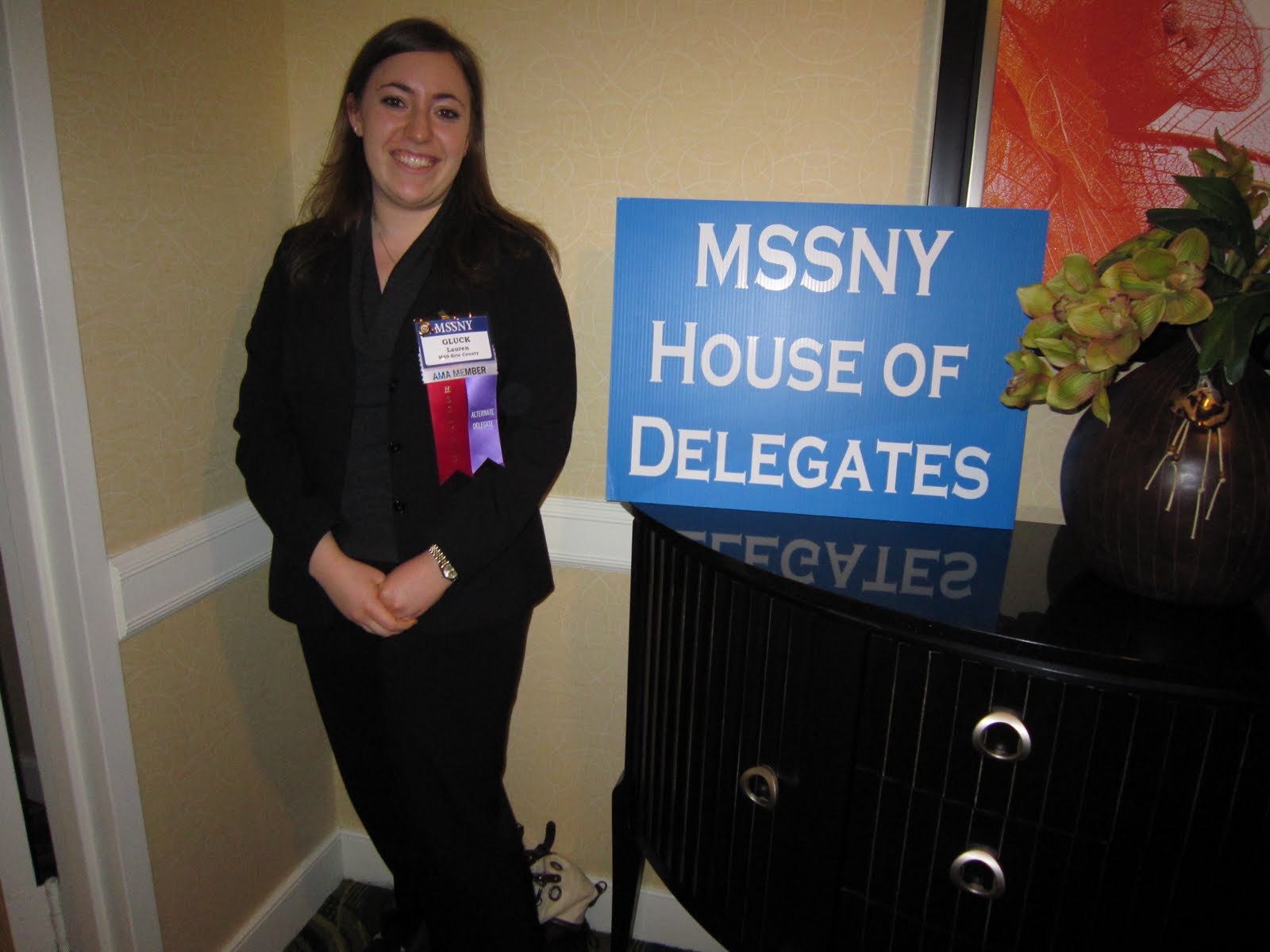 political focus centered on the NYS budget that did not include medical malpractice reform. MSSNY had made a statement that it would not support the budget without these stipulations (caps on pain and suffering litigation, a lower-than-expected fund for infants born with neurological problems, etc.). The HOD was a reminder to all physicians (and future physicians) to play an active role in government by calling up and e-mailing our legislators -- just because we aren't politicians doesn't mean these issues don't affect us!
As far as new policy in the HOD went, the Medical Student Section particularly came out on top. We sponsored four resolutions, all of which were passed by the voting body of MSSNY, the House of Delegates. The proposals were:
1) Promoting financial aid opportunities for NYS medical students. (The importance of this one is fairly obvious.)
2) Expanding graduate medical education (GME) funding for residency spots. The problem is that medical schools keep increasing class sizes and new medical schools are opening, but there are no new residency spots! There is currently a cap on GME funding/new residency spots, and now MSSNY has committed itself to advocate for making sure all of these new doctors will have the appropriate training upon graduation.
3) Expanding MSSNY’s physician database to include an opt-in mentorship program based on race/ethnicity, LGBT status, etc. Based on 2008 data, only 10% of NYS physicians identify as underrepresented minorities, and only about 20% of US medical students do the same.
4) Giving preference to US medical students over offshore students in nearby clerkship sites. This is a big problem in NYC, where many local students are excluded from NYC clerkship rotations due to Caribbean medical schools effectively buying out the clerkship positions.
Additionally, the HOD spent quite a while battling out its position on PPACA. A compromise was reached, and MSSNY’s position is now that it has a specific set of grievances against the bill and supports new legislation to improve any shortcomings, but MSSNY is not 100% against this health care reform.
Overall, it was a very exciting weekend. If anyone is interested in getting involved in the more political side of AMA-MSSNY, contact our VP of Policy/Legislation, Lauren Gluck at lgluck01@gmail.com.
Thursday, March 17, 2011
Congratulations to the UB AMA-MSS Chapter!
We are proud to announce that on March 12th, the Medical Society of the State of New York (MSSNY) awarded the UB American Medical Association Medical Student Section (AMA-MSS) two honorable awards: Chapter of the Year and the Recruitment Award for NY State!
It is officially the tenth consecutive year for our chapter to receive the Recruitment Award! On average we recruit over 75% of the incoming first year medical class to join the AMA - a number that is significantly higher than other NY medical schools. The Chapter of the Year award was a great achievement. The past e-board, led by co-presidents Joanna Lim and Gaurav Rao, successfully held a full year of events. Some of the most notable accomplishments include a Halloween for Children with Diabetes Party, Miles for a Healthier Life Style, and passing a student-written resolution to decrease the price disparity between healthy and unhealthy foods (which is currently being lobbied for in Washington, D.C.).
A new e-board was recently elected and has taken off with a promising start. For example, Linda Wong is leading a Worldscopes Project, CJ Cancino was recently elected to state recruitment chair, and Lauren Gluck is serving as an Alternate Delegate on the state level. We have many new goals set. We plan to focus more on state policy, keeping an updated website, addressing minority issues (such as human trafficking), and simply filling the big shoes left by our predecessors. Several new e-board positions were created to help our more widespread goals for the next year, including Minority Issues Community Liaison, Worldscopes Project Leader, and AMA Student Advisor. There are several upcoming events planned in April so check the website frequently to keep yourself updated!
Please read the recent article about our UB AMA-MSS chapter on the SMBS website: http://medicine.buffalo.edu/news_and_events.host.html/content/shared/smbs/news/2011/03/ama-mss-awards.detail.html
It is officially the tenth consecutive year for our chapter to receive the Recruitment Award! On average we recruit over 75% of the incoming first year medical class to join the AMA - a number that is significantly higher than other NY medical schools. The Chapter of the Year award was a great achievement. The past e-board, led by co-presidents Joanna Lim and Gaurav Rao, successfully held a full year of events. Some of the most notable accomplishments include a Halloween for Children with Diabetes Party, Miles for a Healthier Life Style, and passing a student-written resolution to decrease the price disparity between healthy and unhealthy foods (which is currently being lobbied for in Washington, D.C.).
A new e-board was recently elected and has taken off with a promising start. For example, Linda Wong is leading a Worldscopes Project, CJ Cancino was recently elected to state recruitment chair, and Lauren Gluck is serving as an Alternate Delegate on the state level. We have many new goals set. We plan to focus more on state policy, keeping an updated website, addressing minority issues (such as human trafficking), and simply filling the big shoes left by our predecessors. Several new e-board positions were created to help our more widespread goals for the next year, including Minority Issues Community Liaison, Worldscopes Project Leader, and AMA Student Advisor. There are several upcoming events planned in April so check the website frequently to keep yourself updated!
Please read the recent article about our UB AMA-MSS chapter on the SMBS website: http://medicine.buffalo.edu/news_and_events.host.html/content/shared/smbs/news/2011/03/ama-mss-awards.detail.html
Subscribe to:
Posts (Atom)